HelpHoliday Castles and Villas in Italy
At Holiday Castle Rentals, we now have Castles and Villas in Italy
We have luxury castello and farmhouse holiday rentals (which often go by the name of agriturismo in Italy) in Tuscany, Umbria, the Italian Riviera and Sicily, luxury skiing chalets in the Aosta Valley and Lombardy holiday castles (called castelli in Italia) to rent in Calabria, the Amalfi Coast, as well as elegant Palazzo rentals in Venice, Florence, Rome, Naples, Milan and other cities.
If you would like to book an Italian holiday rental property, please call us and we’ll be happy to tell you all about the other Italian holiday villas and castelli we have about to come on stream and contact villa owners on your behalf to secure your booking. Even if you don’t see your ideal luxury villa rental or holiday castle in our listings yet, please contact us as we have more available than we can post on the site all at once.
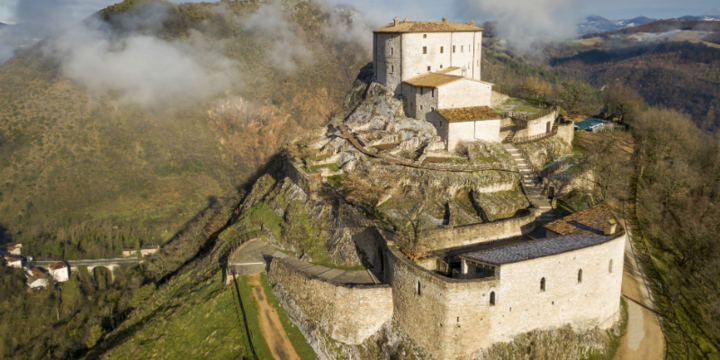
In Italy as in Great Britain, a castello (castle) is a medieval or renaissance military stronghold. The equivalent of renting a country house here is hiring a villa. The urban equivalent of the country house (more similar to France in this respect) is the palazzo, although that term also includes the fortified residences of the merchant princes of the renaissance Italian city states. Unlike in France, though, it is possible to find villa rentals in Italy almost everywhere in the peninsula – it is not so much a question, as in England, of the weight of local interests prevailing over the gravity of central authority, but rather that there was no central authority at all, Italy being until the mid-nineteenth century a patchwork of a dozen or more independent states. As a consequence, you can find a castello or Italian villa to rent anywhere from Sicily to Tuscany to Veneto.
Italy offers a wide range of natural scenery and historical sites to visit; whether you’re in the sunny slopes of the Alps or the stunning orange groves of Sicily, Italy has truly something for everyone. It is a country steeped in history, celebrated for its art and music, and famous for its warm and welcoming hospitality. Italians are well practised at welcoming visitors from all over the world and are excellent hosts.
As one of the most popular holiday destinations in Europe, there is no bad time of year to visit Italy. In summer, Italy is an international melting pot of visitors from all over the world holidaying with Italians at the famous resorts. With over 5,000 miles of coastline, Italy provides an excellent location for a summer beach holiday, and autumn and spring give the holiday maker an excellent opportunity to enjoy all Italy has to offer, with fewer crowds to share it all with. In winter, the Italian Alps are unrivalled for both their breathtaking scenery and superb skiing. Northern Italy has some of the best known ski resorts in the world which are easily reached from Turin in the westerm Piemonte region, Milan, the central mountain hub, and Venice in the east.
Italy has drawn people in search of culture and romance for many centuries. Few countries can compete with its Classical origins, its art, architecture, musical and literary traditions, its scenery or food and wine. The ambiguity of its modern image is also fascinating: since WWII Italy has climbed into the top ten world economies, yet at its heart it retains many of the customs, traditions and regional allegiances of its agricultural heritage.
Italy has no single cultural identity. From the northern snow-capped peaks of the Dolomites, to the long, rugged southern shores of Sicily, lies a plethora of distinctive regions and peoples. Politically, Italy is a young country: it did not exist as a unified nation state until 1861, and its 21 regions have maintained their cultural individuality. Visitors to Italy are often pleasantly surprised by the diversity of its dialects, cuisines, architecture and craftsmanship. There is also a larger regional division. People speak of two distinct Italies : the rich industrial north and the poorer agricultural south, known as Il Mezzogiorno or Land of the Midday Sun. The frontier separating the two is indeterminate, lying somewhere between Rome and Naples.
History and geography have both contributed to the division. The north is closer in both location and spirit to Germany and France while the south has suffered a succession of invasions from foreign powers: Carthaginians and Greeks in ancient times, Saracens and Normans in the Middle Ages and until the middle of the last century, the Bourbons from Spain held sway.
Italian Traditions
Distinctive variations in Italy’s regions have much to do with the mountainous landscape and inaccessible valleys. Tuscan and Ligurian hill-towns, for instance have quite different silhouettes and farmhouses in Puglia are unlike those found in Emilia-Romagna.
For many travellers, the Italian journey comes to an end in Campania, in southern Italy. Further south the territory grows more foreign and the landscape, architecture, dialects, food and even the appearance of the people, have closer affinities with the Eastern Mediterranean or North Africa than with Europe. In the far south, study of the local dialect has revealed traces of ancient Greek and old Albanian, preserved in tightly knit communities isolated by the rugged geography. Christianity and pagan ritual are closely linked; sometimes the Virgin is portrayed as a thinly disguised Demeter, the Earth goddess.
Throughout Italy, ancient techniques of husbandry endure and many livelihoods are closely connected to the land and the seasons. Main crops included wheat, olives and grapes: colourful Easter celebrations pay tribute to the bounty of the soil. Although some of the north’s post war economic prosperity can be attributed to industry (especially car production in Turin), much of it has grown from the expansion of family-owned artisan businesses and the export of hand-made good abroad. This is recognised as a distinct sector of the economy. The internationally successful retain clothes chain Benetton is an example. The ‘Made in Italy’ label, found on goods such as clothes, shoes and leather bags, guarantees a high standard.
Italian Culture and Arts
The arts in Italy have had a long and glorious history and Italians are very proud of this. Given the fact that Italy has more than 100,000 monuments (archaeological sites, churches, cathedrals, houses and statues), all of which have major historical significance, it is not surprising that there is a shortage of funds to keep them in good repair. Many museums in Italy, particularly those in the south, are closed, or partially closed. However with tourism now accounting for a large percent of Italy’s GDP, efforts are being made to put as many buildings and collections on show as possible.
The performing arts as everywhere are under-funded yet there are some spectacular cultural festivals and other events. Opera is a forte, with almost every town of any size having its own opera house. Milan and Verona show world-class productions. Cinema is another flourishing art form in Italy and has been so since its invention. The sets at Cinecitta, outside Rome, have been used by many famous directors such as Fellini, Visconti and de Sica.